Netstock
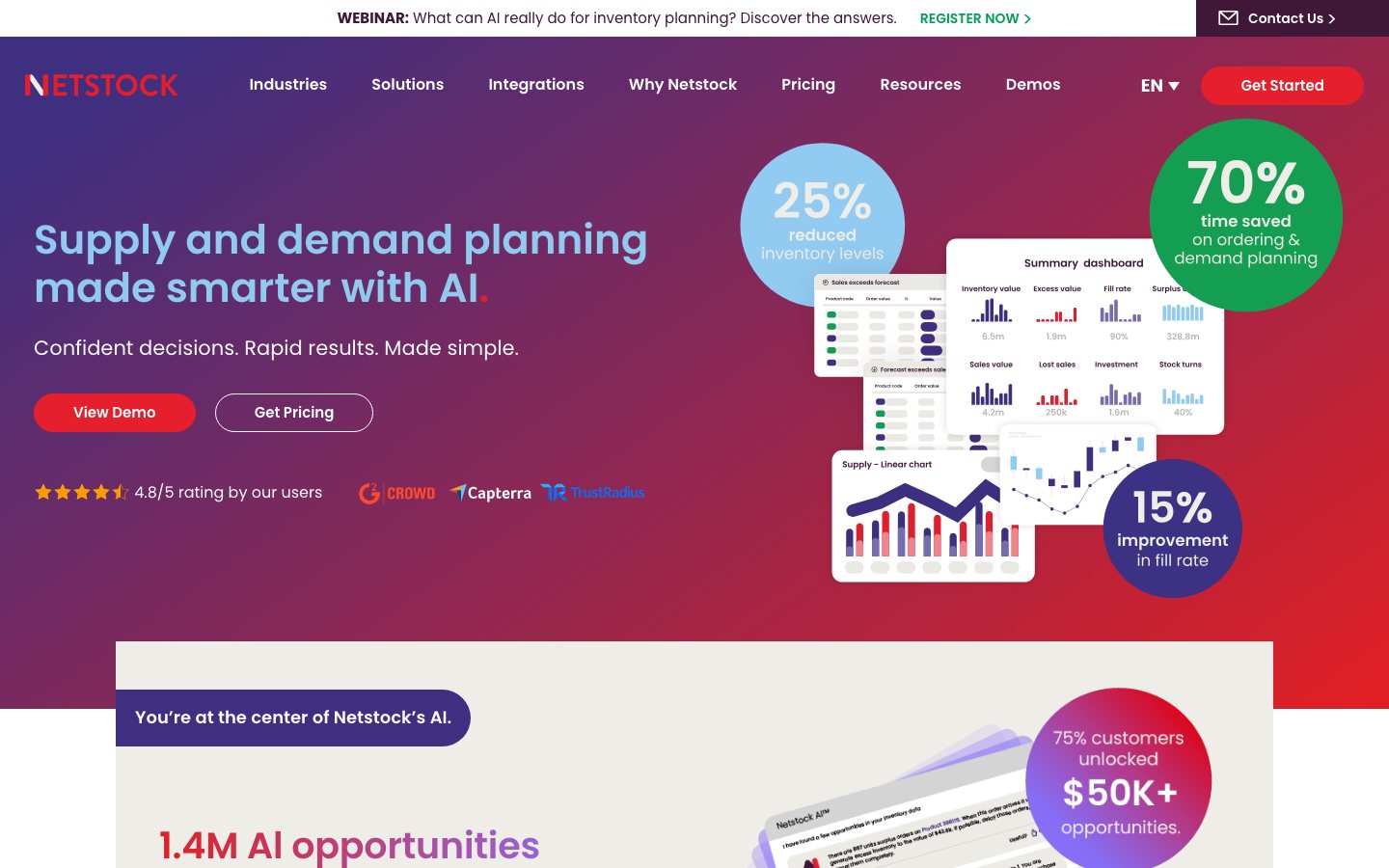
Netstock is a cloud-based supply chain planning and inventory optimization platform designed for SMBs and mid-market businesses. It uses statistical demand forecasting models to predict stock needs accurately, automates replenishment by calculating optimal order quantities factoring in lead times and safety stock, and provides real-time dashboards for inventory health visibility across multiple warehouses. Netstock integrates seamlessly with major ERP systems including Microsoft Dynamics, SAP Business One, and NetSuite, streamlining data synchronization without heavy IT infrastructure.
- Views
- 0
- Uses
- 0
- Favorites
- 0
Core Features
Netstock is a cloud-based supply chain planning and inventory optimization platform designed for SMBs and mid-market businesses. It uses statistical demand forecasting models to predict stock needs accurately, automates replenishment by calculating optimal order quantities factoring in lead times and safety stock, and provides real-time dashboards for inventory health visibility across multiple warehouses. Netstock integrates seamlessly with major ERP systems including Microsoft Dynamics, SAP Business One, and NetSuite, streamlining data synchronization without heavy IT infrastructure.
- Statistical demand forecasting using historical sales data, seasonality, and trend analysis
- Automated replenishment recommendations factoring in lead times, stock levels, and safety stock
- Multi-location inventory tracking with centralized dashboards across warehouses and sites
- Seamless ERP integration with Microsoft Dynamics, SAP Business One, NetSuite, and more
- Customizable reports and dashboards with drill-down capabilities to SKU, supplier, or warehouse level
- What-if scenario planning to model inventory impacts before committing to purchasing decisions
- Low-stock notifications and proactive alerts for stockout risk and excess inventory
Best Fit & Use Cases
You need to prioritize stocking, replenishment, or purchasing decisions. Do not change every step at once: test Statistical demand forecasting using historical sales data, seasonality, and trend… alongside Automated replenishment recommendations factoring in lead times, stock…
Consider it when these outcomes matter: Use Statistical demand forecasting using historical sales data, seasonality, and trend analysis in this step to bring sales, lead time, and availability into one decision; Automated replenishment recommendations factoring in lead times, stock levels, and safety stock; this can surface stockout, overstock, or purchasing signals earlier for review;
Multi-location inventory tracking with centralized dashboards across warehouses and sites, helping you validate in one category, warehouse, or replenishment rule before expanding. Confirm before rollout: Uses a custom quote; confirm the implementation, connector, service, and renewal scope with sales before procurement.
Pricing Analysis
Current published or described options are Custom: Contact sales. This product uses a custom quote: share expected usage, selected modules, channels, and service scope with sales to receive a written price. Prices under different business conditions cannot be compared directly with fixed plans; give each finalist the same volume and scope, then compare total cost and cost per user, order, conversation, or completed execution.
Complete cost also includes inventory or SKU volume, locations, connectors, data cleanup, onboarding, planner time, and cash tied up by recommendations; model both normal and peak periods. A custom quote should state the billing unit, minimum commitment, overages, add-ons, implementation scope, renewal terms, and data-export path.
Pros
- Deep ERP integrations make it a natural fit for businesses already on major ERP platforms
- Accurate demand forecasting reduces both stockouts and excess inventory holding costs
- Cloud-based SaaS model scales without heavy IT infrastructure or upfront hardware investment
- Customizable dashboards provide clear visibility into inventory health at every level
- Supports global operations with multi-currency and multi-unit-of-measure handling
Cons
- Uses a custom quote; confirm the implementation, connector, service, and renewal scope with sales before procurement
- User interface can be difficult for beginners with a noticeable learning curve
- Forecasting algorithms struggle with highly volatile or irregular seasonal demand patterns
- Limited customization for reports and dashboards compared to enterprise ERP suites
Tool scope and price comparison
| Tool | Feature and scope | Official price and billing |
|---|---|---|
| Netstock | ERP-linked demand forecasting, inventory optimization and purchase-order recommendations. Feature source ↗ | Annual subscription; request a scoped quote. Price source ↗ |
| StockIQ | ERP-connected forecasting and replenishment for distributors and manufacturers. Feature source ↗ | Custom quote based on ERP, SKU count, sites and planning complexity. Price source ↗ |
| Inventory Planner | Multi-location purchasing and replenishment for merchants; connects sales channels, inventory systems and ERPs. Feature source ↗ | Quote based on inventory volume; unlimited users stated on the pricing page. Price source ↗ |
Prices checked 2026-09-26. Billing units and product scope differ, so starting prices are not equivalent offers.
Selection advice
Planning on top of reliable inventory records
Netstock fits organizations with a working ERP or inventory system whose forecasting and replenishment still depend on spreadsheets. It uses connected business data to support planning, leaving transaction records in the existing system. Unreliable stock balances or supplier lead times therefore remain a purchasing obstacle rather than a problem that forecasting alone resolves.
Inventory Planner is a closer planning comparison
Inventory Planner is worth comparing for retail and ecommerce teams planning purchases across products and locations. The choice between Inventory Planner and Netstock should turn on the existing data connection, replenishment work and treatment of the team’s own sales history. A similar forecasting label does not prove equivalent recommendations for promotions, stockouts or new products.
Cin7 and Finale for inventory operations
Cin7 and Descartes Finale are relevant when the immediate gap is keeping inventory, orders and channel operations consistent. They overlap with parts of planning but also handle transaction processing, which Netstock is not intended to replace. Cin7 Core is a documented Netstock integration, so an inventory system and a planning product can be complementary purchases.
Katana, Fishbowl and the data needed for a trial
Katana and Fishbowl merit evaluation when materials, production or warehouse operations are the missing capability. That broader operating role should not be treated as proof of the same forecasting depth as Netstock. Before selecting a planning product, the team needs representative SKU and location records, sales history, lead times and open purchase orders to compare purchasing recommendations on a common basis.
Frequently asked questions
What does Netstock inventory planning software do?
Netstock uses inventory, sales, purchasing, and supplier data from a connected ERP to help planners forecast demand, identify stock risks, and prepare replenishment decisions. The underlying transaction records remain in the ERP.
How does Netstock use ERP data for replenishment?
Netstock combines ERP data with planning inputs such as lead time and safety stock to suggest what to order. Planners should check those inputs and the resulting order proposal before acting on it.
Does Netstock publish one standard monthly price?
Netstock directs buyers to request pricing for the products and implementation they need. A useful quote should identify the ERP connection, planning scope, services, and contract term rather than assuming one public monthly rate covers every setup.
Native connections
A prebuilt ERP connection supplies inventory, sales and purchasing data for planning; Netstock says generated orders can be sent back to the ERP.
Netstock ERP integrations ↗Netstock lists a prebuilt Cin7 Core ERP connection for inventory planning and an ordering handoff back to the ERP.
Netstock ERP integrations ↗A documented direct connection imports transaction, stock, supplier and purchasing data into Netstock for forecasts and replenishment planning.
Netstock SAP Business One integration ↗User reviews
Netstock product profile on G2.
I really like the visuals, the deep-dive features, and how easy it is to work with the forecasting models. The onboarding process has been smooth, and the support staff have been great as well.
I really like the incredible amount of visibility that Netstock offers. I use all the tools from projections to dashboards, and they're highly visible data, which is really important across different channels and different teams. Netstock saves a lot of time and doesn't require me to be an inventory genius. Making decisions based on the data I see rather than assembling it manually is a huge advantage for the business. I'd definitely rate it a 10 out of 10.
Netstock product profile on Capterra.
"Great Inventory Management Tool"
Netstock has improved inventory planning and reduced stock issues. Overall, it’s a reliable and valuable solution.
"NetStock Review"
Experience has been really good. Service is outstanding and it was a really good business fit for our company. It has changed the way we manage, maintain and forecast inventory going forward and critical to our business success.
"Good, not great"
We're still trying to figure out how we can maximize the use of all the data. Also the surprise rate increase was rather unwelcomed.
Netstock written reviews on TrustRadius.
Netstock Review
Before using Netstock, we had a visibility problem which meant that we could not predict quickly and accurately the stock levels of a product over the next few months. We work with very long lead times and being able to have good visible and easy to use data is extremely important to both ourselves and our clients. We also used to work in silos in excel spreadsheets, meaning each state worked in its own special way creating a risk for the company, we now have all the same processes and the data is available and explicit to anyone.
Use Netstock for peace of mind.
We use Netstock for future forecasting, cash flow management, and Stock KPI's. Prior to Netstock, we used Excel spreadsheets, which were high risk because only one person knew how they worked and could use them. Now with Netstock, we have a cloud-based system with multiple users who understand how the system works and can see live what is going on.
Netstock for Wholesaler
We personally use it most for demand planning and reordering. It has taken the need of manually performed excel workbooks to determine our demand and ordering. Saved significant amount of time on that front. We have used it a little bit for distribution between our two warehouses although not as much as I thought.
Netstock
Content checked:
I am in purchasing and it has made me more efficient in all of my tasks. We have a dozen vendors and over 30k SKUs (mostly inactive) but still a lot to manage. Prior to Netstock I used Excel and this was unworkable. Netstock now creates my orders for me and with the correct setup, review is minimal. We use a hub and spoke model and have 6 spoke DCs that we distribute product to so I also use the "Order from distribution center" function to create my transfers. Overall, Netstock has allowed me to manage more of the business than would have been possible before.