Algolia AI Shopping Assistant
Algolia helps ecommerce teams deliver product search, recommendations, and merchandising. Its alternatives section covers other search and discovery tools for a store's shortlist.
- Views
- 0
- Uses
- 0
- Favorites
- 0
Core Features
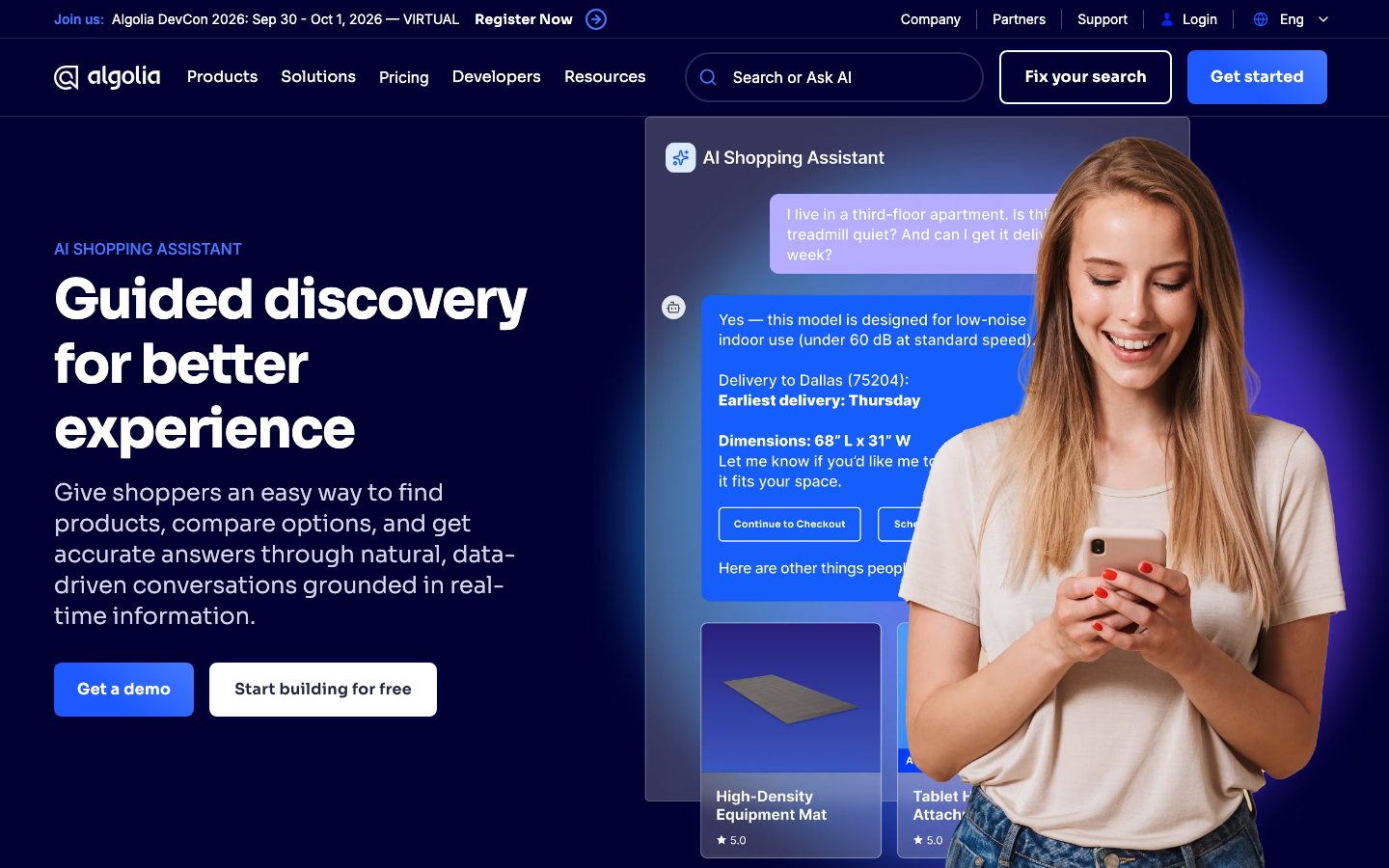
Algolia is an AI-powered search and discovery platform used by 17,000+ companies including Stripe, LVMH, and Under Armour to deliver instant product search, recommendations, and merchandising. Its NeuralSearch combines keyword matching with semantic AI understanding, returning sub-20ms results across web, mobile, and AI agent interfaces. The platform also includes A/B testing, dynamic re-ranking, and a merchandising studio for non-technical teams to control product visibility.
- NeuralSearch combining keyword and semantic AI vector search
- Instant search-as-you-type with sub-20ms response times
- AI-powered product recommendations with Dynamic Re-Ranking
- Merchandising Studio with no-code product ranking controls
- Built-in A/B testing with statistical significance analysis
- Federated multi-source search across product catalogs and content
- Revenue Analytics connecting search interactions to purchase data
- Personalization engine building user affinity profiles
Best Fit & Use Cases
You see shoppers struggle to find, filter, or rank the right products. The first decision to test is whether NeuralSearch combining keyword and semantic AI vector search and Instant search-as-you-type with sub-20ms response times hold up together before removing one clear…
Consider it when these outcomes matter: NeuralSearch combining keyword and semantic AI vector search, helping you help shoppers reach a relevant product set faster; Put Instant search-as-you-type with sub-20ms response times into the current flow to keep operational control over ranking and product rules; Use AI-powered product recommendations with Dynamic Re-Ranking in this step to validate on one page or query range before extending from behavior data.
Confirm before rollout: Usage-based pricing scales rapidly — costs can spike unexpectedly with traffic growth.
Pricing Analysis
Current published or described options are Free: $0 (10K requests/month); Build: $1 per 1,000 requests; Grow: From $129/month; Premium: Contact sales; Elevate: Contact sales. Free has the lowest acquisition cost for validating the workflow, while Build is the first useful cost baseline for steady use.
A higher tier earns its premium through measurable labor savings, revenue lift, or lower unit cost—not through a longer feature list alone. Complete cost also includes monthly orders or traffic, feature packages, platform-tier requirements, implementation, experimentation, and incremental margin; model both normal and peak periods. A custom quote should state the billing unit, minimum commitment, overages, add-ons, implementation scope, renewal terms, and data-export path.
Pros
- Industry-leading sub-20ms search speed at global scale
- Free tier available with 10,000 requests per month
- Deep customization of ranking, filtering, and relevance controls
- Strong developer ecosystem with SDKs for all major frameworks
Cons
- Usage-based pricing scales rapidly — costs can spike unexpectedly with traffic growth
- Advanced features like A/B testing and multi-cluster require Premium or Enterprise plans
- No self-hosting option, creating vendor lock-in risk
- Complex setup requires significant technical resources
Selection Guidance
Document the current manual process, data sources, owner, and recovery path, then run one high-traffic journey or merchandising placement with a control group with real business data. Cover permission boundaries, null and exception data, duplicate execution, human override, third-party sync delays, export, and rollback.
Also run these product checks: Test one normal case, one edge case, and one case with a deliberately missing critical field.; Compare the result with the pre-test baseline for conversion rate, revenue per visitor, add-to-cart rate, and guardrail metrics; do not record time saved alone..
Keep the pilot live for a complete business cycle and compare conversion rate, average order value, revenue per visitor, response latency, and merchandising effort with the pre-pilot baseline. Contract only if quality, controllable risk, and total cost all pass, and explicitly test these known constraints: Usage-based pricing scales rapidly — costs can spike unexpectedly with traffic growth; Advanced features like A/B testing and multi-cluster require Premium or Enterprise plans.
Quick Comparison
Algolia alternatives differ most in product scope, operating ownership, and billing model. This matrix compares hosted ecommerce discovery suites with general search infrastructure, including the storefront and data work each option leaves with the buyer.
| Product | Product scope | Best fit and implementation | Pricing and billing |
|---|---|---|---|
| Algolia AI SearchCurrent product | Hosted API-first search, browse, recommendations, personalization, analytics, and rule-based merchandising for ecommerce and other search applications. | Best fitTeams that want managed search infrastructure, broad developer APIs, and a merchandising dashboard while retaining control of the storefront experience. ImplementationEngineering uploads and synchronizes product records into Algolia indexes, integrates the search UI, and sends click and conversion events with query IDs. Supported ecommerce connectors can reduce integration work. | Public priceFree $0; Grow and Grow Plus are billed monthly on pay-as-you-go usage; Elevate requires a custom annual contract. Billing basisFree includes 10,000 search requests and 50,000 records/month. Grow includes 10,000 searches and 100,000 records, then charges $0.50 per 1,000 searches and $0.40 per 1,000 records; Grow Plus charges $1.75 and $0.40 on the same overage units. Algolia pricing |
| Constructor | Enterprise ecommerce search, browse, recommendations, collections, merchandising controls, product-data enrichment, and shopping or merchant agents. | Best fitRetailers that want an ecommerce-specific discovery suite and merchant-facing controls built around catalog and shopper-behavior data. ImplementationThe buyer connects its product catalog and shopper clickstream, then integrates the selected onsite experiences. Constructor's evaluation path uses the buyer's own products and data. | Public priceNo public platform price; the purchase path is sales-led. Billing basisThe Shopify connector is free to install, but external Constructor platform charges are billed separately. The official purchase route begins with a discovery call and product demo; contract units and allowances are not publicly stated. Constructor sales demo |
| Nosto Product Experience Cloud | Personalized search, category merchandising, recommendations, post-purchase upsell, dynamic bundles, and personalized email, with a separate Content Experience Cloud in the wider Nosto platform. | Best fitCommerce teams that want search inside a broader retail personalization and merchandising platform, with the option to buy selected modules. ImplementationThe buyer connects product, customer, content, and behavioral data through a commerce-platform integration or developer implementation. Qualified merchants can run a structured proof of concept with their own store data. | Public priceCustom quote; no public amount and no standard self-service free trial. Billing basisPricing combines a base platform fee with a fixed fee based on business volume. The quote varies with GMV, traffic, selected modules, and the required support or scalability level; qualified merchants can receive a proof of concept. Nosto pricing |
| Elasticsearch / Elastic Cloud | General-purpose keyword, vector, and semantic search infrastructure with serverless, hosted, and self-managed deployment choices rather than a packaged ecommerce merchandising suite. | Best fitEngineering-led teams that want control over deployment, indexing, query logic, relevance, and the storefront application built around search. ImplementationThe buyer chooses a deployment, ingests product data, builds query logic and the storefront UI, and owns relevance evaluation. Elastic manages infrastructure only for hosted or serverless deployments. | Public priceElastic Cloud Hosted starts at $99/month. Serverless starting rates are $0.09 per search VCU-hour, $0.14 per ingest VCU-hour, $0.07 per ML VCU-hour, $0.047/GB-month for storage, and $0.05/GB for egress. Billing basisThese are infrastructure units, not ecommerce request prices. Deployment type, compute, storage, egress, support, and the buyer's engineering work all affect total cost. Elastic pricing |
Pricing basis: September 9, 2026. Per-request SaaS charges, GMV-based quotes, and infrastructure consumption are not directly interchangeable, so every price remains in the vendor's published unit.
User reviews
Exact Algolia AI Search & Discovery Shopify app listing; reviews cover this app listing, not every Algolia product surface.
App is a bit clunky to use at times, with unexpected errors popping up when trying to apply changes. Most of the time, redoing the action solves it but nonetheless, it's time consuming. Algolia dashboard is quite useful and has lots of features/capabilities for nuanced execution. Algolia staff and support are super helpful (shout out to our TAM Elias) and bring a lot of experience in helping our business optimize and execute strategy.
Algolia has made search much faster and more relevant on our store. We especially like the control over rankings, synonyms, filters, and merchandising.
Exact Algolia product profile on OMR Reviews.
Suchergebnisse und Algorithmen auch für Einsteiger
Einfache Integration der Algolia-Software für die Suche auf unserer Webseite. Die Daten der Videos können leicht eingelesen werden und Algolia bietet viele Einstellungsmöglichkeiten zur Anpassung eines individuellen Sucherlebnisses. Zusätzlich zur Suche bietet Algolia auch einen Bereich für Vorschläge (Recommendations) an. Diese Recommendations nutzen wir um Usern passende Video-Vorschläge anzuzeigen und um Videos, die aktuell im Trend sind, mehr Usern anzuzeigen. Der Fokus von Algolia liegt bei klassischen Shops, dies ist in den Einstellungen und besonders in der Recommend-Funktion ersichtlich. Besonders für Empfehlungen wären weitere Einstellungsmöglichkeiten abseits der typischen Onlineshop-Anforderungen hilfreich. Die Recommendations-Funktionen sind aktuell noch am Anfang und es können nur wenige Regeln für die Vorschläge festgelegt werden. Hier fehlt es noch an zusätzlichen Individualisierungs-Möglichkeiten für die Algorithmen. Für die Suche nach passenden Videos haben wir Algolia eingebunden. In Algolias Datenbank sind alle Informationen pro Video gespeichert und über die Algorithmen und Sucheinstellungen bekommt der User ein passendes Suchergebnis zu seiner Eingabe. Zusätzlich verwenden wir die Recommandation-Funktion um dem Usern passende Vorschläge anzuzeigen. Damit müssen keine eigenen Algorithmen geschrieben werden. Algolia kann praktisch unendlich viele Datenpunkte als Input für die Algorithmen sammeln, stellt aber nur den Output in Rechnung.
Perfektes Testing verschiedener Engagement-Funktionen für User aus der eigenen Website mit Algolia
Uns hat sofort die Untergliederung in "Indices", "Analytics" und "API Keys" im Tool Algolia sehr zugesagt. Mittlerweile kristiallisieren sich auch im Team unterschiedliche Verantwortlichkeiten je nach Teilbereich im Tool heraus. Wir profitieren vor allem davon, dass wir relativ unkompliziert verschiedene Interaktionsmöglichkeiten testen und weiter entwickeln können. Das Geniale daran ist, dass wir im Algolia Tool sofort die Auswirkungen von Anpassungen auf der Website im Bereich "Performance" sehen und auch nachvollziehen können. Wir haben bei uns im Team einzelne Personen, die nicht so firm mit Online-Tools wie Algolia haben. Für diese war nicht sofort alles intuitiv verständlich. Alles in allem erinnert Algolia aber schon vom Grundsetting und dem Aufbau an bekannte Tools und Systeme. Sodass die meisten von uns sich relativ schnell im Tool zurecht gefunden haben. Dabei ist auch ein großer Vorteil, dass die Hauptnavigation von den Oberpunkten sehr beschränkt ist und man nicht sofort von 10 verschiedenen Bereichen erschlagen wird. Durch Algolia konnten wir innerhalb kürzester Zeit das User-Erlebnis auf unserer Website deutlich optimieren. Das schöne ist, dass sich Anpassungen unmittelbar in den Analytics-Daten widergespiegelt haben und damit schnell klar ist, welche Anpassung positiven und negativen Einfluss hat. Den größten Nutzen hat Algolia in unserer Suchfunktion auf der Website (Onsite Search) gebracht. Wir konnten viele leerlaufende Suchanfragen nun entweder den relavanten Suchergebnissen zuordnen oder entsprechenden Bedarf für neuen Content ermitteln.
Die flexible Suchmaschine für alle
Die vielfältigen Möglichkeiten die Suchbegriffe über Algolia zu analysieren sind großartig. Zudem können direkt für verschiedene Suchcluster Regeln angelegt werden. Auch die Vorschau für die Ergebnisse funktioniert sehr gut. Man kann direkt sehen, welche Produkte durch welche Faktoren auf den jeweiligen Plätzen landen und ggf. optimieren. Ebenfalls in der Vorschau werden direkt noch die Regeln angezeigt die bei einem bestimmten Suchbegriff greifen. Ein stärkeres Clustern von Suchbegriffen fehlt aktuell und muss sehr kleinteilig eigenständig angelegt und in Algolia übertragen werden. Hier gibt es bereits Anbieter die großzügiger Clustern und damit weniger Arbeit entsteht. Wir zeigen unseren Kunden hiermit die besten Ergebnisse für Ihre Suchanfragen. Durch das einfache Eingreifen in die Suchkriterien und den guten Support konnten wir unsere CV für die Suche verbessern. Die automatisierten Synonyme und Rechtschreibvorschläge sind eine echte Hilfe in der regelmäßigen Verbesserung der Suchergebnisse.
Exact Algolia product profile.
Algolia is easy to integrate, it has also great documentation and & support service.
Over the years with algolia, we did not experience any issue or downtime. There was no need to contact their support team for anything, it just works perfectly. Nothing from my side. They have an awesome documentation that is up to date. It is helping the dummy search engine that was bild with exact match in mobile apps. Alternative option was to use solr, but it needed extra ram and wasn't feasible to integrate. Algolia is now able to feed the apps with results that might have typo in them. This is also saving our customer service unnecessary tickets.
AI-Powered Search with more control than Drupal default site search
No changes since that last report. The personalization is continuing to run and capture data on the site. Improve cost; it is a non-trivial cost. Giving the website admins more control over the site search. We can come up with our search results ranking strategy and manage it in the Algolia dashboard. It's way more transparent than the basic site search ranking rules we'd get through Drupal or Wordpress. Then there's the AI powered part that pays attention to what users are searching for and personalizes their website experience from there.
Not longer as useful as before.
Actually nothing new, theyve kept their product the same at least for my use case, so nothing new to add. Now with LLMs there is a lot a search motor can do, that algolia does not, so having context searches, vector related searches and other things could be somthing to be done by it, but still does not. I'm using search results as an autocomplete based on a knowledge base I created from user documents, algolia is making all the hard work and helping me with the searching and autocompletion
Algolia
Content checked:
Overall a really solid app — no major issues and it integrates smoothly into our workflow. Would love to see a bulk edit option added for collection facets, as that would save a lot of time managing larger catalogs. Our TAM Elias has been incredibly helpful and supportive throughout our experience.